Tesla Roadster "flight": how the compressed-air hop works
Tesla Roadster "flies" in Texas: it is really a compressed-air hop
Dribook Editorial·October 25, 2026·9 min read
Share:
Tesla Roadster "flies" in Texas: what happened
The new-generation Tesla Roadster made short hops on compressed air. It didn't fly like an aircraft. On October 15, 2026, at SpaceX's rocket test site in McGregor, Texas, near Waco, thrusters lifted the car off the ground and it landed on its wheels, according to CBC News (October 16, 2026). CBC News reported that production is planned for 2028, so the car shown that night isn't a production model.
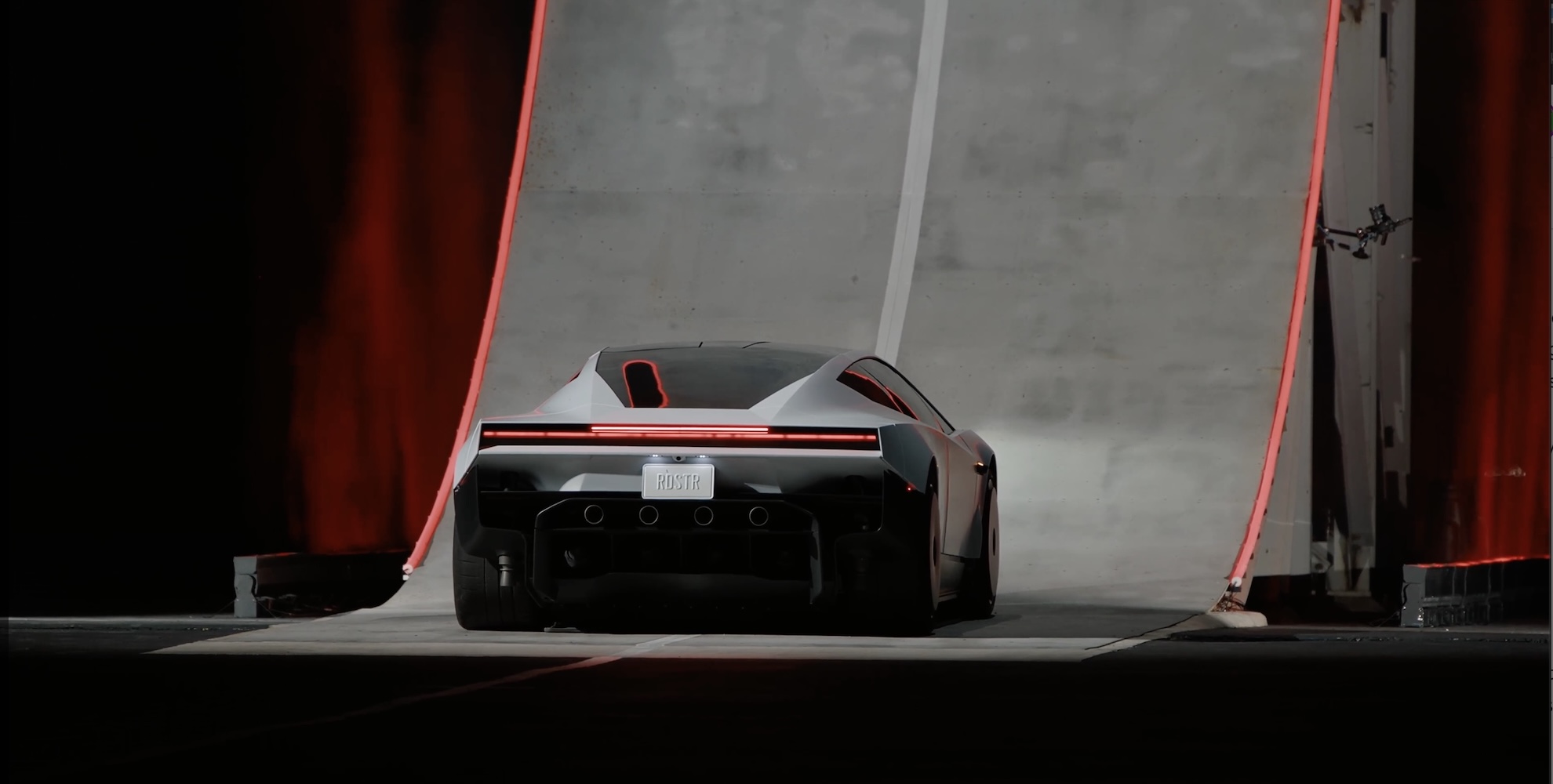
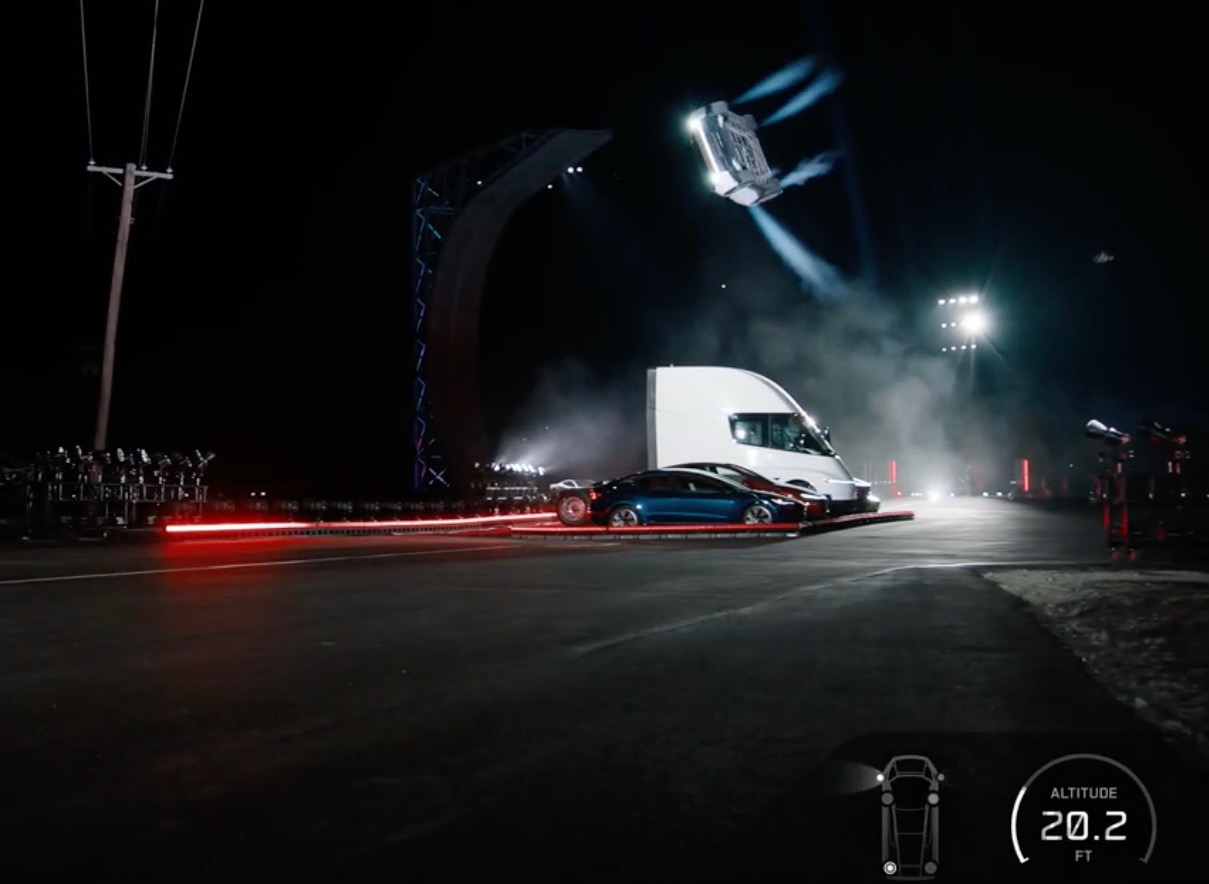
The car drove up a curved ramp, hung upside down on suction from under its floor, left the ramp, flipped in the air and landed (CBC News). While moving, it hopped over a Cybercab, Cybertruck, Tesla Semi, Model Y and Model 3, according to TechCrunch (October 15, 2026). Dezeen (October 16, 2026) reported that it also lifted off from a standstill. Dezeen added that the show was a pre-programmed sequence with no driver. Even so, Tesla called the car "the best of the last human-driven cars" on X, according to Fox Business (October 15, 2026).
The Roadster in mid-air above a Tesla Semi and two sedans on the night of the reveal, October 15, 2026, in McGregor, Texas. Photo: Tesla
Quick take
On October 15, 2026, in Texas, the new Tesla Roadster made short hops with nobody inside.
There are three versions, Performance, Thrust and Rocket, and Tesla is targeting production in 2028.
The thrusters run on compressed air, burn no fuel and come only on the Thrust and Rocket.
The car only hopped, with no long flight. The "rocket" feature isn't approved for public roads.
The new range claim is less than half of the 2017 promise.
Still unknown: the purchase price (Musk didn't name one) and the exact 0–97 km/h time of the demo run.
Not a rocket: how compressed air pushes the car
The new Roadster burns nothing. On the Thrust and Rocket, cold-gas thrusters release compressed gas through nozzles, and the reaction pushes the car along, according to Fox News (October 18, 2026). The gas is stored in composite overwrapped pressure vessels (COPVs), which fill "every usable void" in the car, Tesla said on X (TechCrunch).
Fans under the car, rather than the thrusters, hold it upside down on the curved ramp. They pull enough air from beneath the floor to keep it hanging inverted, according to TechRadar (October 16, 2026). Top Gear (October 16, 2026) calls this ground effect: drawing air out from under the floor to press the body onto the road. Tesla says side skirts adjust themselves to each road surface (TechRadar). The fans are electric (Fox News).
Underbody suction: holds the car to the surface, even upside down. Fitted from the Performance up.
Cold-gas thrusters: extra push, and on the Rocket they also lift the car and set it down. Compressed air: 200 liters (Thrust) · 600 liters (Rocket, adding 400 liters where the passenger seat was).
Two systems, two jobs. Source: Tesla, via Fox News, TechRadar and Top Gear.
The Thrust has four rear-mounted thrusters. They push the car straight ahead only, so it keeps accelerating even if the tires slip. The Rocket has 10 thrusters (four at the rear, six at the front and sides). The front and side group helps the car brake, turn and hold its heading, and points down to lift and land it (Top Gear). In more detail, per MotorTrend (October 16, 2026), four nozzles just behind the wheels point down for vertical thrust; two on the nose point left and right for yaw.
How the Tesla Roadster clings upside down, lifts off, turns and sets down using suction fans and compressed-air nozzles
Illustration: dribook, based on MotorTrend, Top Gear, Fox News and TechRadar, retrieved October 24, 2026.
According to Top Gear, the Thrust's tank empties in six seconds, so the thrusters work only in short bursts. That tank sits in the trunk, Tesla vehicle engineering chief Lars Moravy told Hagerty (October 16, 2026). At the event, Musk said: "the car can recharge its air tank — it's not like you need special propellant or anything like that" (TechRadar). Refilling the Rocket prototype's tanks currently takes six to seven hours, according to Moravy, and Tesla hopes to cut that time (Fox News).
"Flight" or "hop"? What the demo didn't prove
According to Dezeen, the jump off the ramp lasted only a few seconds. After the show, CNN (October 15, 2026) wrote that it "certainly didn't have any demonstration of long-range flight." That matches what Roger Connor, curator for vertical flight at the Smithsonian National Air and Space Museum, told CNN before the event: "We're not talking about sustained flight. We are literally talking about hopping." He also made a general point about car–aircraft hybrids: such a vehicle "is going to be a poor performing aircraft and a poor performing vehicle."
Nobody was inside the car during the show. Musk said this was "to make sure we don't kill anyone." Before the show, he said success wasn't guaranteed, though it would probably work, and if it failed, everyone was at a safe distance (CNN). So the hop over the lineup proves only that the machine can perform the move by itself. Nobody has yet seen how a driver would handle it.
According to CBC News, the fine print under the "rocket" feature on Tesla's website reads: "Not approved for public road use." David Vladeck is a law professor at Georgetown University. He was formerly director of the Bureau of Consumer Protection at the US Federal Trade Commission (FTC). Vladeck said: "I'm not sure every state is going to allow a driver in the middle of traffic to suddenly elevate himself and fly."
Three versions: Performance, Thrust, Rocket
Tesla opened reservations for three versions: Performance, Thrust and Rocket. Every figure below is a Tesla claim, not yet verified by a third party. TechCrunch reports that all three share the same range, over 480 km (300 miles) (CBC News). Tesla's claimed top speed for the Roadster is over 370 km/h (230 mph) (CBC News). The clearest difference between the three is the hardware that pushes the car. The Performance has two seats and no thrusters. The Thrust has two seats and adds four rear-mounted thrusters. According to CBC News, Tesla describes the Rocket as having a "full flight system." It has 10 thrusters (four at the rear, six at the front and sides) and gives up the passenger seat for compressed air, so the Rocket has one seat.
0–97 km/h: Performance under 1.6 s
0–97 km/h: Thrust under 0.9 s
0–97 km/h: Rocket under 0.59 s
Tesla's claimed times, converted by dribook. Source: Tesla, via TechRadar and Fox News.
Those three times are Tesla's listed specs for each version. The figure Moravy gave at the event measures something else: one demo run reached 0–97 km/h in under one second (CBC News). He didn't say which configuration made the run, so it confirms no version's claim.
Performance reservation: $50,000
Thrust reservation: $250,000, limited release
Rocket: invite only
Source: Tesla, via Fox News and TechRadar.
Musk didn't name a purchase price, so these aren't car prices. Both reservations take $5,000 up front and the rest within 10 days. The money is refundable until the configuration is finalized, but it isn't held in escrow by a third party (Fox News).
Tesla itself doesn't promise that the Roadster is safe or finished. Musk said: "If you buy a Ferrari, safety is not the number one goal. I say, if safety is your number one goal, do not buy the Roadster" (TechCrunch). The Rocket, the version with the most thrusters, is also the one Tesla warns hasn't been approved for public road use (Fox News). The reservation agreement states that the car is still under development and that Tesla can't guarantee when, or whether, a car will be delivered (Fox News).
Nearly nine years of waiting: from the 2017 promise to October 15
Tesla showed the second-generation Roadster on November 16, 2017, according to TechCrunch (November 16, 2017). The promise then included 0–97 km/h in 1.9 seconds, a 200 kWh battery and a starting price of $200,000. On October 15, 2026, nearly nine years later, the car that appeared had thrusters added. The range Tesla now claims is less than half of what Musk promised in 2017, according to CBC News (October 16, 2026), citing Reuters.
Musk mentioned thrusters in a tweet on June 9, 2018, according to Fortune (June 10, 2018). He wrote: "SpaceX option package for new Tesla Roadster will include ~10 small rocket thrusters arranged seamlessly around car … Maybe they will even allow a Tesla to fly …" That count matches the Rocket revealed in 2026, which has 10 thrusters (Top Gear). These ones fire compressed air, though.
Deliveries were promised for 2020, then pushed back in 2020, 2021, 2023 and 2024, according to TechCrunch (October 15, 2026). By 2026, the delays were only about the event date. Tesla explained the last one on X, according to Electrek (September 28, 2026): "given the severe conditions predicted & because this event can only be held outdoors, we've made the difficult decision to reschedule."
November 16, 2017: second-generation Roadster shown, with deliveries promised for 2020.
June 9, 2018: Musk mentions rocket thrusters.
2020, 2021, 2023, 2024: the Roadster is delayed.
November 2025: the shareholder meeting sets the reveal for April 1, 2026.
October 1, 2026: the event is postponed because of weather.
Musk called the underbody suction fans "Better than any James Bond car" (TechRadar). He owns an actual Bond car. According to CNBC (October 18, 2013), it's the Lotus Esprit submarine prop from The Spy Who Loved Me. Musk bought it at an RM Auctions sale in London for $989,000, in 2013. He planned to fit it with a Tesla electric drivetrain. That submarine was on display at the reveal (TechCrunch).
The new Roadster draws on models from both the road and the air. On the road, it's the Lotus Esprit, a design inspiration according to Top Gear and the same model line as Musk's submarine. In the air, Tesla cites the SR-71 reconnaissance aircraft and the F-35 fighter (TechCrunch). The Lotus link goes back further: the first-generation Roadster (2008 to 2012), Tesla's first electric car, was built on a Lotus Elise chassis (CBC News).
Musk called the car "the culmination of incredible work by Tesla and SpaceX engineers working closely together" (CBC News). Headlines leaned on the SpaceX side too: TechRadar wrote that the car has "SpaceX rocket thrusters," even though all they release is compressed air. Musk also said Tesla might try to jump the Snake River Canyon, where Evel Knievel once attempted a crossing in a steam-powered rocket (TechCrunch).
On February 6, 2018, the first Falcon Heavy flight carried Musk's own Tesla Roadster. According to Guinness World Records, it was the first mass-produced car sent into space. Guinness says the car is in an elliptical orbit around the Sun and could stay there "for millions or perhaps billions of years."